
Why a 21-day onboarding cycle wasn’t just a “software” problem – it was a talent sustainability problem.
In commercial banking, the most dangerous metric isn’t server uptime, it’s Time-to-Revenue.
We recently worked with a prominent bank operating across the Caribbean that faced a critical crisis. Their commercial onboarding process, the phase where a handshake turns into a funded account, was averaging 21 days.
In a major financial hub like London or New York, 21 days is unacceptable. But in a multi-island environment, it was becoming an existential threat. The bank was losing high-net-worth clients to agile fintechs, not because their products were worse, but because their process was exhausted.
When we arrived on-site, we found that the issue wasn’t just “old code.” It was a misalignment between their architecture and their operational reality. Here is how we analyzed and solved a complex multi-jurisdictional challenge.
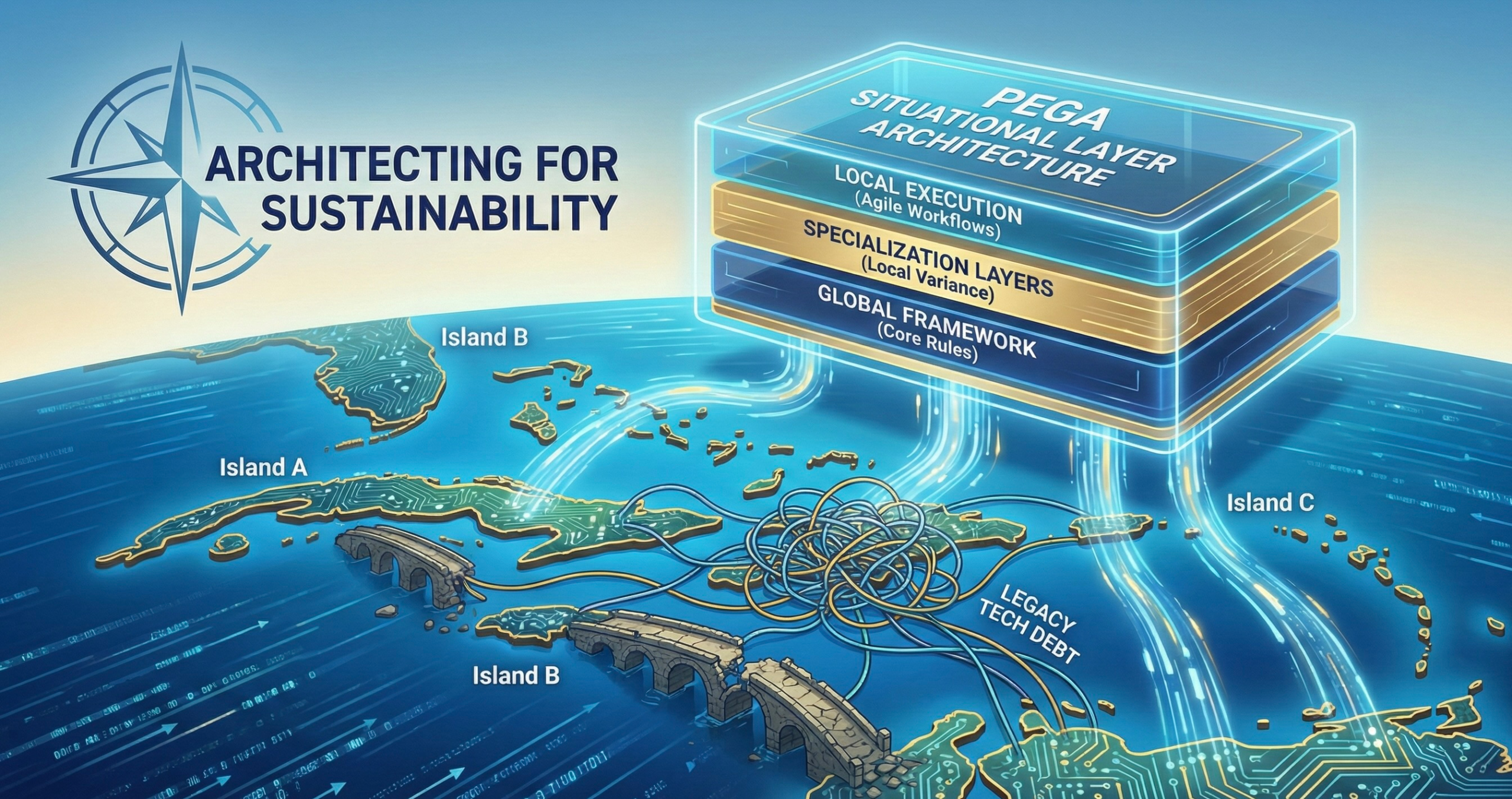
The Hidden Constraint: Geography as Technical Debt
In a centralized bank, if you need to patch a legacy Java application, you hire a contractor. In a distributed island operation, that specialized talent simply might not exist locally.
We found that this bank’s “tech problem” was actually a “staffing reality” problem. Their legacy system required high-code maintenance that they couldn’t easily staff for.
- The Symptom: Relationship Managers (RMs) were managing million-dollar account openings using Excel spreadsheets and sticky notes.
- The Root Cause: They weren’t avoiding the system because they were stubborn; they were avoiding it because the IT backlog was paralyzed. The centralized team couldn’t deploy changes fast enough to keep up with local regulatory shifts.
The architectural takeaway: You cannot build a system that is more complex than the team available to maintain it. We had to shift to Low-Code not just for deployment speed, but for business continuity.
The Solution: Solving Multi-Jurisdiction with Pega’s Layered Architecture
The most complex aspect of this implementation wasn’t the workflow; it was the variance in law. The Bahamas has different compliance rules than Barbados, yet both roll up to international AML standards.
A standard “hard-coded” approach would have required separate codebases for each island, a maintenance nightmare.
Instead, we utilized Pega’s “Situational Layer Cake” architecture.
- The Global Framework: We built a common core for banking rules (representing about 80% of the logic).
- The Specialization Layers: We pushed the island-specific variances (tax forms, document checklists) into specialized layers.
Architect’s Field Note: “The mistake many banks make is hard-coding local regulations into the core banking layer. By decoupling the ‘Global Policy’ from ‘Island-Specific Rules,’ we enabled the Jamaica branch to update a local tax requirement without risking a regression error that would break the workflow for the Cayman Islands branch.”
Refining the “Happy Path” vs. The Exception Path
The second major bottleneck was the Anti-Money Laundering (AML) checks. The bank was drowning in manual reviews.
Integrating an API to a global watchlist (like WorldCheck) is standard practice. The architectural challenge is handling the noise.
- The Problem: The legacy process treated every “hit” as a stop-work event. If a client’s name resembled a sanctioned individual, the file froze.
- The Logic Tune: We moved the focus to Exception Handling. We tuned the decision logic to auto-resolve “low-confidence” hits (False Positives) based on secondary data points (DOB, Citizenship).
This reserved high-value human capital for high-probability risk matches, reducing the Compliance team’s manual workload by nearly 70%.
The Results: Sustainability Over Speed
The immediate metric everyone cheered for was speed: the average onboarding time dropped from 21 days to 4 days.
But as an architect, the metric I valued most was Resilience. Because the new solution utilizes a Low-Code/Model-Driven approach, the local IT teams on the islands, who are talented but generalists, can now maintain the workflow logic without needing to fly in a specialized Java developer. The system is no longer fragile.
Conclusion: Process vs. Workaround
If your onboarding flow relies on the heroic efforts of staff using spreadsheets rather than a system that supports them, you don’t have a process, you have a workaround.
Modernization isn’t about buying a new tool; it’s about aligning your technology with the reality of your talent pool and your regulatory environment. It might be time to stop patching the legacy code and start rethinking the architecture.